The Wing Tsun System
Siu Nim Tau
The 1st form translates to 'the way of the little idea' or 'little idea', serving as the foundation of the system and equipping you with everything needed to begin your journey in self defense training. This form emphasizes upper body movements and stance, which are essential in mastering Kung Fu techniques as well as in Wing Tsun training.
Chum Kiu

2nd Form is 'Seeking the bridge'. This form incorporates movement and kicks into your Kung Fu techniques, enhancing your self defense training. It demonstrates turning, shifting, and stepping, which are essential elements of Wing Tsun training.
Biu Jee

The 3rd Form, known as 'Flying/Thrusting Fingers', is an essential part of self defense training that builds upon the foundation of the previous two forms. This technique emphasizes the release of your force while incorporating various Kung Fu techniques to strike soft targets using different parts of your body. Additionally, it equips practitioners with backup strategies essential for effective Wing Tsun training when situations don't go as planned.
Chi Sao & Chi Gerk
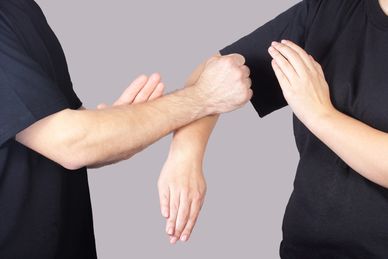
Chi Sao, or "sticky hands," are essential in Wing Tsun training and represent the heart and soul of the system. This self defense training technique teaches many valuable lessons, such as how to feel where a force is, how to redirect it and counter, and where the gaps are in both your defense and your opponent's. The ultimate goal is to develop automatic responses, skin reflexes, and a transformation in your nervous system—skills that are particularly useful when you have no time to think and need a quick reaction. The same applies to your legs or 'Gerk'.
Wooden Dummy
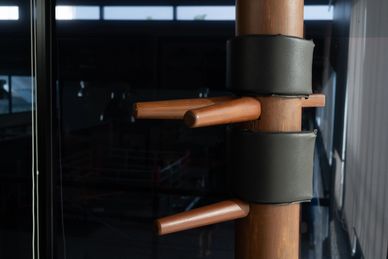
The wooden dummy, known as the 'Mook Jan Jong,' translates to wooden man post. After mastering the forms, you can refine your Kung Fu techniques here, focusing on close-range footwork and control. This practice also enhances your self defense training, teaching you how to strike a hard object and use your whole body as one, among other skills, all integral to Wing Tsun training.
Long Pole
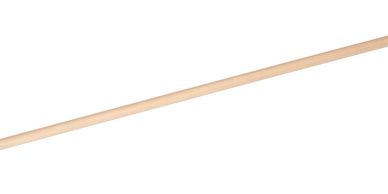
The Long Pole, known as 'Luk Dim Boon Kwun', translates to a 6 1/2 point pole. This weapon is the longest range tool in our Kung Fu techniques, making it an essential part of self defense training. With its tapered end designed for delivering devastating hits, it plays a crucial role in Wing Tsun training.
Baat Cham Dao
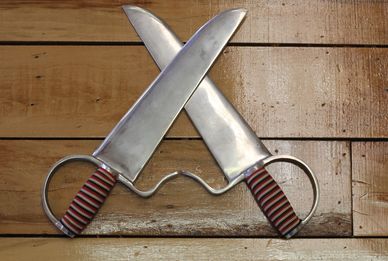
The Baat Cham Do are the Butterfly Knives. They translate to the '8 cutting/slashing blades.' The techniques learned here are usually the final part of the system that a practitioner learns. It connects to your forms and should act as an extension of those techniques, enhancing your Wing Tsun training.
BCCMA

As a member of the BCCMA (British Council for Chinese Martial Arts) our system is accepted as an authentic Chinese Martial Art.